
Cradle to Cradle Certified®
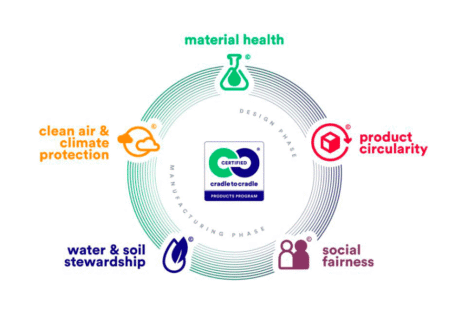
Design your products according to circular economy principles from ‘cradle to cradle’. Put your brand at the center of circular design with globally recognized sustainable product certification, assessed across five dimensions from material health to social justice.
What is Cradle to Cradle®?
The Cradle to Cradle approach aims to transform products into a new resource at the end of each life cycle, rather than a linear cycle from “birth to waste” (cradle to grave). Cradle to Cradle Certified® is an independent product certification scheme that translates this approach into concrete criteria and can be applied across different product categories.
The certification aims not only to reduce environmental impact, but to turn material flows into “continuous positive cycles”. Your product must no longer just be “less harmful”, but reusable, recyclable and safely recycled back into the biological or technical cycle.
Material Health
All ingredients are evaluated for toxicology; substances harmful to human and environmental health are gradually removed from the formulation.
Product Circularity
The modular design, easy disassembly and monomaterial approach aim to ensure that the product can safely enter the technical or biological cycle at the end of its life cycle.
Social Justice
Human rights, working conditions, ethical procurement and community impacts in the supply chain are secured through company policies and audit mechanisms.
C2C Assessment Areas
The Cradle to Cradle Certified® Product Standard evaluates products in five main categories and sets key criteria for each category.
Put Your Product at the Center of the Circular Economy…
Get a free pre-assessment for Cradle to Cradle Certified® product certification from our team of experts and let us map out your circular design roadmap.
Certificate Levels
the road from BRONZE to PLATINUMThe Cradle to Cradle Certified® program uses a structure of Bronze, Silver, Gold and Platinum levels to give designers and manufacturers the opportunity for gradual progression. For each category, the product is rated at one of these levels and the final level of certification is determined by the lowest level among the categories.
For example, if material health is Gold and water management is Silver, the overall certification level is Silver. This gives teams a clear picture of where further improvements are needed.
Cradle to Cradle® Certification Process
With USB Certification, the C2C journey is designed as a holistic process ranging from strategy definition, inventory and data collection, pre-assessment and design improvement to independent assessment and certification.
Frequently Asked Questions
Check Our Other Services

Textile and Recycling Certification
USB Certification offers textile and recycling certification services. Contact our team of experts to learn…
Better Cotton Initiative Chain of Custody (CoC)
Certify your sustainable cotton supply chain with Better Cotton Initiative CoC. Verify eco-responsible production with…
RecyClass
Certify the recyclability of your plastic packaging with RecyClass. Apply to USB Certification today for…
Regenevate
Certify your sustainable farming practices with Regenevate certification. Improve soil health and biodiversity. Apply now!
You may be interested in these topics (Newsletter & News)
Cradle to Cradle Products Innovation Institute Publishes C2C…
Certify the circularity and sustainability of your products with the C2C Certified® Circularity Standard. Contact…
Cradle to Cradle Certified Version 5.0 Enters into Effect
Cradle to Cradle Certified V5.0 is here. Explore a new era in sustainable product certification…
Better Cotton Initiative’s Transition to Certification
Better Cotton Initiative is working to drive long-term impact by promoting more equitable and sustainable…

NEXT is certified to the Textile Exchange Standards
Certified by USB Certification under the NEXT, GRS, OCS, RCS, RWS, RDS, RMS, and RAS…
