
ISO 27001 Information Security Management System
Protect your corporate data, reduce risks and ensure business continuity with ISO 27001 Information Security Management System. Click now for professional solutions!
What is ISO 27001 Information Security Management System?
In today’s digital age, information has become one of the most valuable assets of businesses. Therefore, protecting information assets is not only a necessity but also a strategic imperative. ISO 27001 Information Security Management System (ISMS) is an international standard that helps organizations protect their information assets, manage risks and reassure interested parties.
The most current version of the standard published by ISO was published in 2022 as ISO 27001:2022.
ISO 27001 represents the management approach an organization takes to ensure information security. This approach includes policies, processes and controls. This system, which covers information security, cyber security and privacy protection, aims to protect organizations’ information assets, processes and risk management.
ISO 27001 sets out requirements to enable organizations to effectively manage information security. This standard covers processes such as classifying information assets, identifying, assessing and managing risks. It also includes steps such as establishing information security policies, implementing security controls and conducting continuous improvement activities.
Importance of ISO 27001 Standard
The ISO 27001 standard offers organizations many advantages and plays an important role in the field of information security:
Protecting Information Assets
ISO 27001 helps organizations protect customer and employee data, trade secrets and other valuable information. In this way, businesses are protected from loss of reputation and legal problems. Unauthorized access and data loss are prevented through processes such as classification of information, determination and protection of access authorizations.
Legal Compliance
ISO 27001 facilitates compliance with legal regulations such as KVKK (Personal Data Protection Law). Organizations that meet the requirements of the standard prove that they fulfill their legal obligations and are protected from possible sanctions.
Ensuring Business Continuity
ISO 27001 helps organizations ensure business continuity. It guarantees the continuity of business processes even in the event of a possible information security breach. This is especially vital for organizations operating in critical industries.
Mitigating Risks
ISO 27001 includes processes for identifying, assessing and managing information security risks. In this way, organizations can identify potential risks in advance and minimize the effects of data breaches and cyber attacks by taking appropriate measures.
For Which Businesses Is ISO 27001 Certificate Required?
ISO 27001 is a standard suitable for all organizations that want to establish an information security management system or improve their existing system. It is especially important for businesses operating in sectors such as information and communication technologies, finance, health and law. In addition, public institutions, organizations that provide and receive external services related to information technologies, organizations that carry out R&D and design activities and process big data should also apply this standard. In addition, the ISO 27001 Standard is also very important for organizations that manage information on behalf of others and can be used to assure customers that their information is protected.
Secure Your Information Security
Protect your corporate data against internal and external threats, systematically manage your risks and ensure your business continuity with ISO 27001 Information Security Management System. Start your certification process today and contact us to bring your information security infrastructure to international standards.
Key Elements of the ISO 27001 Standard
Security Policy
Establishing a policy that determines the organization’s information security objectives and management approach.
Risk Assessment
It is the process of identifying and assessing risks to information assets. In this process, potential threats and vulnerabilities are analyzed.
Risk Management
It is the process of implementing the necessary controls to manage and mitigate identified risks.
Control and Audit
It is the process of regularly monitoring and auditing the effectiveness of information security controls. This ensures continuous improvement of the system.
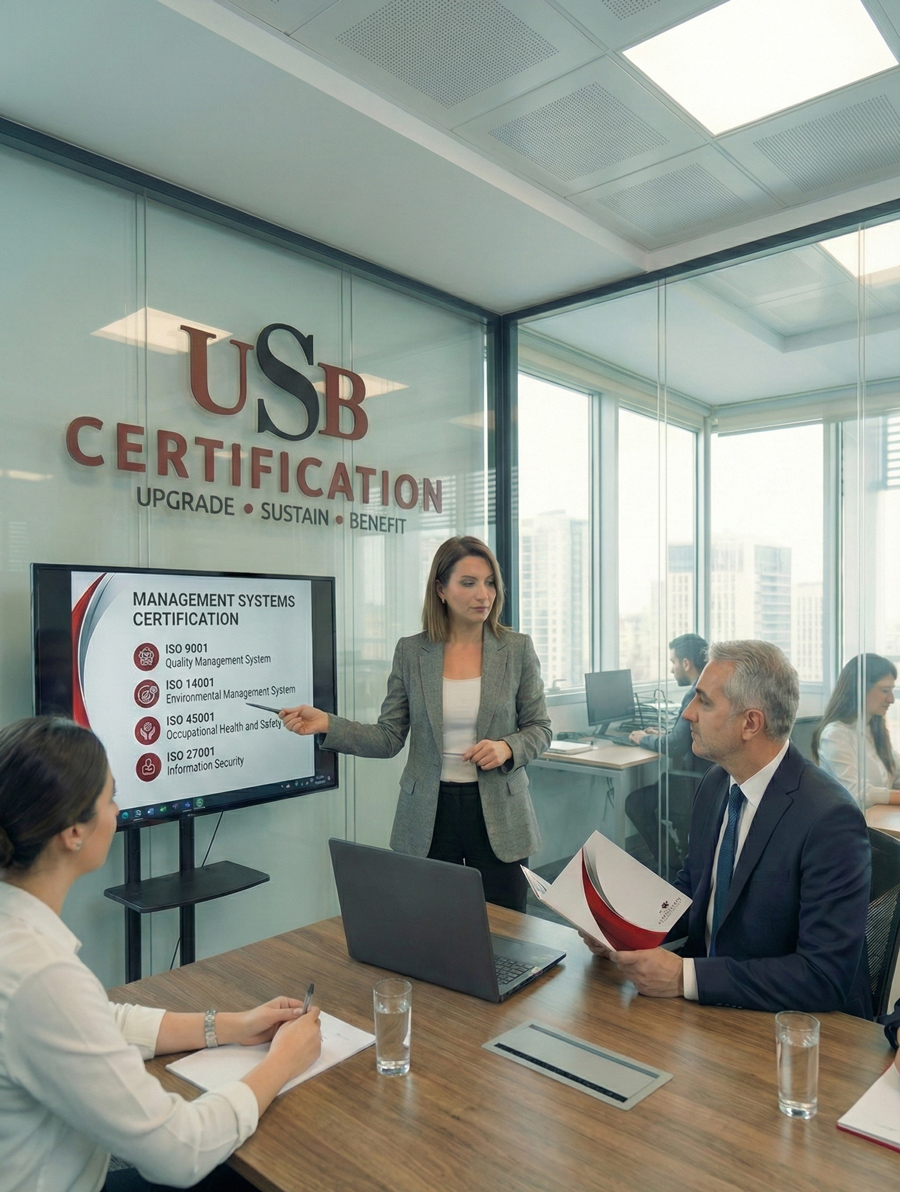
ISO 27001 Information Security Management System Certification Process
Organizations wishing to obtain ISO 27001 Information Security Management System Certificate, after establishing the information security management system, certification is carried out as follows.
Certification Audit:
Completion of the certification audit in two phases;
Stage 1 Audit: General examination of the documentation prepared by the company within the scope of ISO 27001 Information Security Management System.
Stage 2 Audit: On-site control of the documentation applications prepared by the company within the scope of ISO 27001 Information Security Management System and identification of appropriate and possible inappropriate issues.
Corrective Actions, Follow-up Audit and Certification:
If nonconformity is detected in the Stage 2 Audit, ISO 27001 Information Security Management System Certificate of Conformity is issued after the nonconformity is closed by the organization applying for certification or by the certification body with a follow-up audit according to the type and size of the nonconformity.
Surveillance Audits:
Surveillance audits are audits carried out in the second and third years after the certification audit. In surveillance audits, it is determined that the organization’s processes continue correctly after certification.
If non-conformity is detected in the surveillance audit, it is decided to continue the ISO 27001 Information Security Management System Conformity Certificate after the non-conformity is closed by the organization audited or by the certification body with a follow-up audit according to the type and size of the non-conformity.
Periodic surveillance audits are mandatory for the validity of the ISO 27001 Information Security Management System Standard Certificate and to determine that the organization’s management system continues to comply with the standard.
These periodic surveillance audits are 1st Surveillance and 2nd Surveillance audits. The first of these surveillance audits must be completed within 12 months after the Stage 2 audit and the second within 24 months after the Stage 2 audit.
Recertification Audit:
It is a type of audit conducted in the fourth year after the Stage 2 audit and conducted to organizations that implement the ISO 27001 Information Security Management System Standard and have undergone the first certification audit. As in Stage 2, 1st Surveillance and 2nd Surveillance audits, the documentation and application of the organization is checked by on-site audit.
Benefits of ISO 27001 Certification
Obtaining ISO 27001 Certificate provides many benefits to organizations
- Mitigating and controlling information security risks and threats.
- Increased customer and stakeholder trust.
- Strengthening corporate reputation.
- Ensuring legal compliance and protection from sanctions.
- Gaining competitive advantage.
- Increased efficiency in processes and reduced costs.
- International recognition and credibility.
Frequently Asked Questions
Check Our Other Services
ISO 9001 Quality Management System Certification
Elevate your company to international standards with ISO 9001 Quality Management System certification. Contact us…
ISO 22301 Business Continuity Management System
Protect your business from disruptions and safeguard customer satisfaction with ISO 22301 Business Continuity Management…
ISO 14001 Environmental Management System Certification
Reduce your environmental impact and lower your costs with ISO 14001. Apply to USB Certification…
ISO 37001 Anti-Corruption Management System
Fight corruption with ISO 37001 and strengthen your ethical values. Contact USB Certification today for…
You may be interested in these topics (Newsletter & News)

Comprehensive Inspection and Surveillance Services According…
USB Certification provides a wide range of services within the scope of ISO/IEC 17020 “Conformity…

ISO 19011:2026 Revision Published: New Era in Audit Approach
The revision of ISO 19011:2026 has ushered in a new era in audit processes. Click…

2026 Revision of ISO 14001 Environmental Management System S…
ISO 14001:2026 Environmental Management System standard is here. Get the latest information on changes and…
